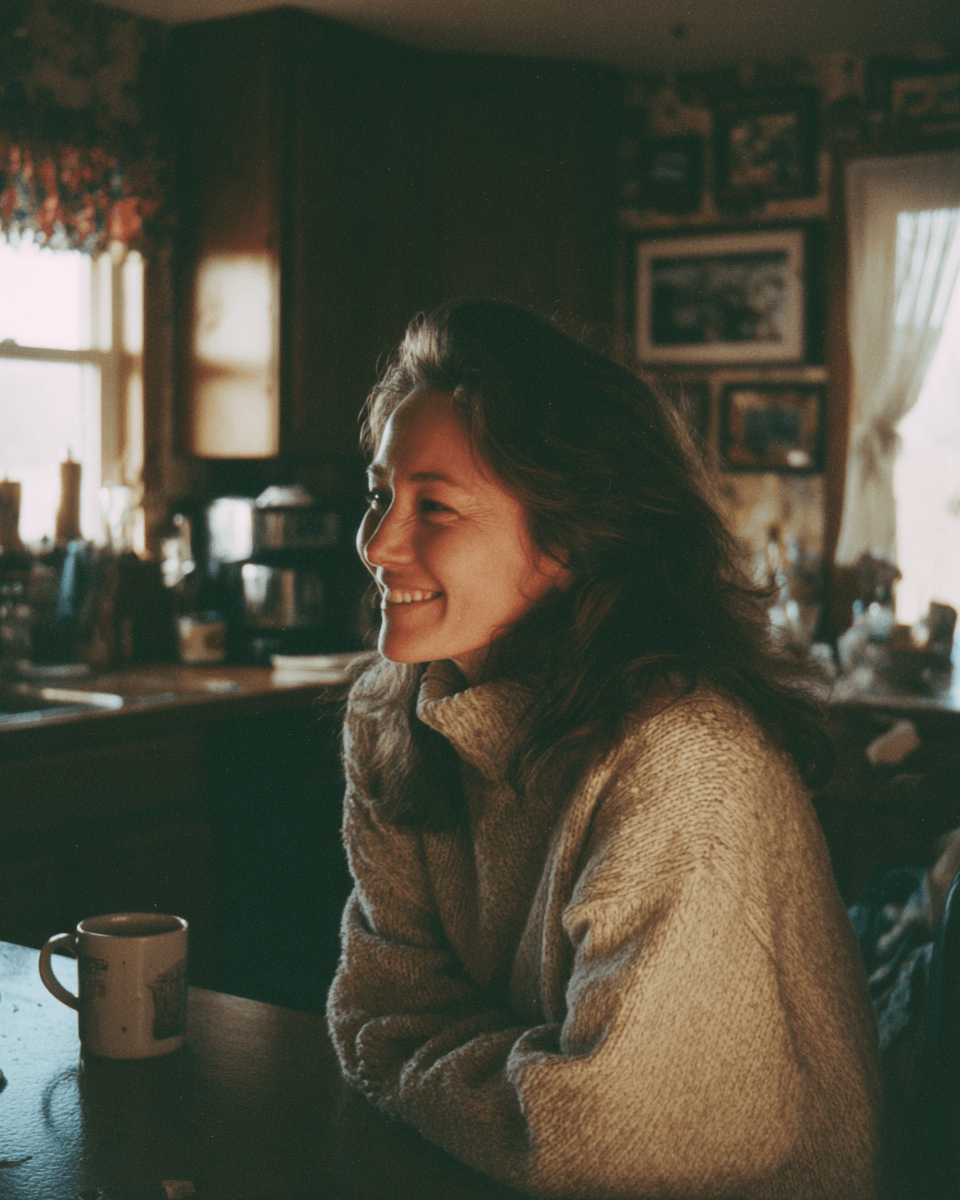
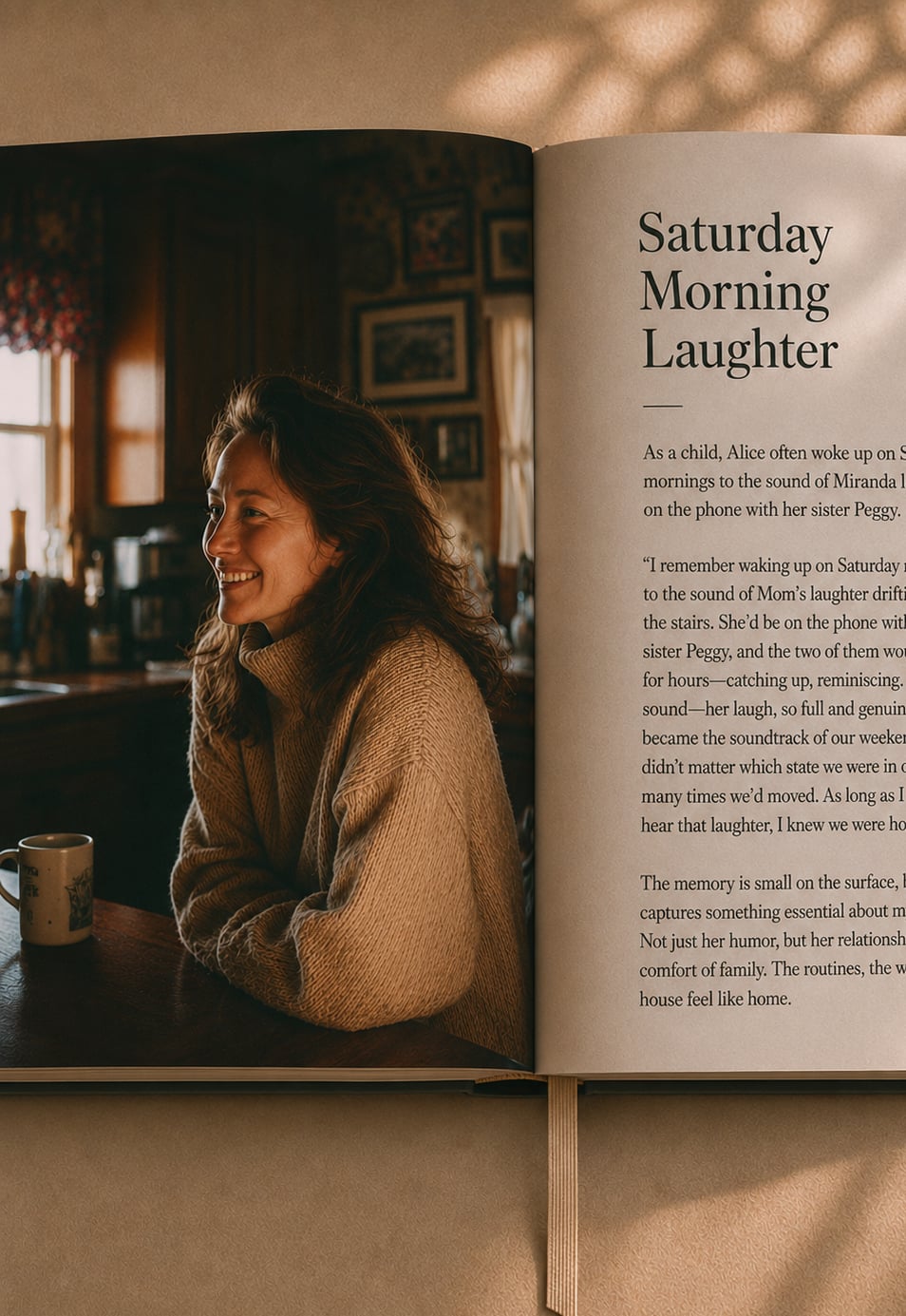
A living biography of a person: their stories, life events, the people they loved, the photographs they cherish. Drawn from guided interviews with anyone you choose to invite.
Invite anyone with a story to tell. Sharing is as easy as having a 5-minute conversation. Lori, our AI-guided interviewer, asks the questions, records the answers, and turns the transcripts into a cherished collection you can read and keep forever.
As little as 5 minutes, as often or as rarely as you like. Lori is a skilled interviewer, not a generic chatbot. She acts with empathy, remembers what was said last time, and keeps a running list of follow-ups.
A biography is rarely one voice. Invite family, siblings, old friends. Anyone who is part of the story. Each contributor adds their own perspective, photos, and memories.
“It was the summer of ’62.”
“I have the photo. Workbench, back of the shed.”
“It was after Dad came back, not before.”
“There’s a tape of him and the radios.”
Read a chapter, browse an interactive timeline, reminisce on old photos of times you’d forgotten. Add memories whenever they come up. It’s yours forever.
On the bulletin board in the waiting room of Thorsen Veterinary, there is a wall of Polaroids, put up, piece by piece, by Patty Engelson…
Prompts in an inbox get lost. Blank pages get put off. A real conversation, with someone who listens and responds, is the one format that tends to work for anyone, no matter the age or technical ability.
Below is a real sample biography, built from fifteen short conversations. Chapters, timeline, people, and photos are all produced from the same conversation transcripts.
Thorsen Veterinary, Glenwood, Minnesota, 1976–2016
On the bulletin board in the waiting room of Thorsen Veterinary, there is a wall of Polaroids. They have been there long enough that the oldest ones have gone pale at the edges — the colors fading into that warm amber that old photographs use to announce their age. Farmers who have been coming to the clinic since the early 1980s barely notice the wall anymore, the way you stop noticing a window once you know the view. But it is there, and it is full, and it was put up — piece by piece, animal by animal — by a woman named Patty Engelson, who understood early on that the woman who ran the clinic would never build such a thing for herself.
Patty worked alongside Solveig Thorsen for thirty-two years. She has precise opinions about this. "Doc Sollie hated putting anything on the board herself," she says. "She said it was ’tooting our own horn’ — so I did it." This is not a small distinction. It is, in some ways, the whole of the chapter.
In the summer of 1976, Solveig Thorsen was twenty-eight years old and in possession of a veterinary degree, a signed bank note, and a set of keys to a clinic at 412 Central Avenue in Glenwood, Minnesota — a flat-roofed building on the west side of Lake Minnewaska where Doc Lindberg had been treating dairy cattle and barn cats since the 1950s. She was, by one measure of the world she was entering, a historical fact: the first woman veterinarian west of St. Cloud. By her own measure, she was simply a person with work to do.
The loan had been cosigned by her father, Olav Haugen, who had also put a second mortgage on the family farm to make it possible. The day they signed at the bank — a summer morning in Glenwood, the kind of day that moves slowly before the heat builds — Olav wore a tie. This was unusual enough to be noticed. On the drive back, he said one thing: "Sollie, we’ll be fine." That was all. Four words, the weight of a farm behind them.
She came in the following morning at four-thirty to set up the schedule book. The clinic was hers now — the front desk with its smell of antiseptic and old wood, the exam table worn smooth by a generation of anxious animals, the parking lot where farmers would pull in before dawn with sick animals in their truck beds. She had worked two years for Doc Lindberg after graduating from the University of Minnesota’s College of Veterinary Medicine in 1974, learning the particular rhythms of western Minnesota dairy country — which farmers were cautious, which were cavalier, what it meant when a herd had been sick for three days before anyone called. Now the practice was hers, and the blank page of her first week’s schedule was waiting.
Except it wasn’t blank. Doc Lindberg had filled it in for her — the whole week, clients and times and notes — so she wouldn’t have to begin from nothing. "He was that kind of man," Solveig says simply, in the compressed way she has of paying tribute. It was a small gesture and a large one. The schedule book said: You are not starting over. You are continuing something. She had named the practice Thorsen Veterinary from day one — her name, not his, not a neutral corporate placeholder — but Doc Lindberg’s filled-in week was its own kind of inheritance, a quiet door held open so the next person wouldn’t have to push through alone.
Erik Thorsen, who was approximately one year old that summer and therefore at his grandparents’ house on opening day, would later compress his mother’s first years into a single astonishing sentence: she went from new veterinarian to clinic owner to mother in twenty months. He is not wrong. Solveig’s son arrived in the middle of everything she was building. She kept building.
The hours were, as Erik would later describe them, brutal. Calving calls at two in the morning, barn visits at six, clinic hours from nine to four, then farm calls until dark. The clinic ran six days a week. Solveig ran the seventh from her truck. The route took her to dairy farms across Pope County and into the counties on either side — long flat roads between fields of corn and soybeans, silos catching the late light, the perpetual smell of manure and turned earth that she had known since childhood, since the mornings she stood beside her father Olav in the barn before school. She had left the land but reproduced its rhythms exactly. The animals didn’t know the difference, and neither, quite, did she.
In the summer of 1983, a Border Collie pup named Whisper got hit by a hay wagon on the Holm farm. The dog couldn’t be safely moved to the clinic, so Solveig drove out and performed orthopedic surgery on the Holm family’s kitchen table. Whisper walked again.
That Christmas, the Holm kids brought a Polaroid to the clinic. Patty Engelson had been working there for a year by then — she had answered a handwritten HELP WANTED sign in the front window in 1982, been interviewed for fifteen minutes, and been asked to draw blood from a barn cat that Solveig had produced, as if from thin air, on a towel in the middle of the office. She had done it. Solveig had said: "Patty, can you start tomorrow at six?" That was the interview. Patty had been nineteen years old. She had recognized immediately what kind of operation she was walking into.
So when the Polaroid arrived — Whisper standing in the snow, plainly alive and plainly pleased about it — Patty tacked it to the bulletin board in the waiting room. Solveig pretended not to notice. By 1985, there was a whole wall.
The wall was, in its way, a running argument. Solveig’s position was that the work was the point; displaying the outcomes was a form of self-congratulation that she found vaguely embarrassing. Patty’s counterposition, never explicitly stated, was that a record ought to be kept. Someone ought to know. And so for thirty-two years, Patty kept it — every Polaroid, every Christmas card, every thank-you note from a family whose animal had come home. Solveig never touched it. She also never asked Patty to take it down.
The world the clinic operated in was particular and demanding. Western Minnesota dairy country in the 1970s and ’80s was a landscape of Holstein herds and debt cycles and weather that could turn a profitable year into a disaster in an afternoon. The farmers Solveig served had no margin for error and no patience for a vet who wasted their time. They also — many of them, in those early years — had no experience being treated by a woman.
Solveig did not address this directly. She simply kept showing up, kept being competent, kept learning the specific quirks and anxieties of each operation she served. Patty handled what might be called farmer diplomacy — the gentle art of managing the men in the waiting room who needed a moment before they were ready to accept what they were seeing. Solveig’s bedside manner with humans was, as Patty once summarized it, "practical and short." With animals, she had what Patty called "infinite patience." The farmers, over time, learned to take the arrangement as offered.
Karl Nygaard, who would become Solveig’s husband in 1992 and who spent thirty-five years as a University of Minnesota agricultural extension agent working across the same dairy farms she served, met her at the Pope County fair — where they got into an argument about a Guernsey heifer’s body condition that Solveig won. He recalls the professional world she operated in with a precision that comes from having shared it. Their paths crossed constantly on dairy farms across western Minnesota. He knew the farmers. He knew the work. He understood what it meant, in that particular world, to be the person everyone eventually called for the hard cases.
Her peers from three counties called her for the difficult ones. She took them all.
There is a ledger line in the books at Thorsen Veterinary that reads, for fifteen years running: barter, lawn mowing.
The patient in question was a tabby cat belonging to Mr. Lundgren, who lived somewhere nearby and was on disability and could not pay for veterinary care. Solveig treated the cat anyway, every time it needed treating, and recorded the service as an exchange for lawn mowing — because Mr. Lundgren had, in fact, mowed Olav and Margit Haugen’s lawn for a couple of seasons. Then he just kept coming in. So did the ledger line. It ran for fifteen years without comment, a small and complete portrait of a woman who believed that the accounting didn’t need to be made public in order to be real.
Around 2007, at three in the morning, at the Engdahl dairy, a heifer had been in labor for four hours. Solveig arrived, assessed, and reached in with her bare hands. No equipment — just her hands and her knees in the straw. The calf was breech and weighed ninety pounds. It lived. The Engdahls named him Doc, after the woman who had pulled him into the world before sunrise.
She never let anyone tell the story.
This is worth sitting with for a moment: a ninety-pound bull calf, delivered by hand at three in the morning, named for the woman who saved him — and she wouldn’t let it be told. Not because she was ashamed of it. Because she didn’t think it required an audience. The work had been done. The calf was alive. That was the end of the story, as far as Solveig Thorsen was concerned.
Patty had another view of what the end of the story looked like. She had been watching for long enough to know that not all the stories ended that way.
She never cried at the clinic. In thirty-two years, Patty never saw it. But she learned to read what happened instead — the signs of a day that had gone wrong and was being quietly absorbed.
When Solveig lost an animal, she cleaned her instruments more carefully than usual. She wrote out the case notes in long form rather than shorthand — full sentences, full observations, as if the completeness of the record could compensate for the outcome it described. Sometimes she took a longer drive home. Three towns out of the way, a route that made no practical sense, as if the body needed the extra miles to settle.
Once, after they lost a foal — the Petersen pasture, ten miles north of town, a relationship that ran three generations deep — Solveig stopped on the way home and stood at the fence with the cows for half an hour. Patty drove past and saw her there, a figure in the early-evening light at the rail, not moving. She kept driving. "She wouldn’t have wanted me to" stop, Patty says. Thirty-two years of knowing someone, and what you know, finally, is what they don’t need from you.
The Halverson bull was a Holstein that had been the family’s pride — the kind of animal a dairy operation organizes itself around, the proof that the generations of selection and care had been worth it. Solveig couldn’t save him. The farmer, Halverson, was crying in the barn afterward. Solveig sat with him until midnight without saying a word. Then she drove home.
Karl — who had heard the story from Patty, who had been told by another farmer, in the way that news travels in small agricultural communities — confirmed what happened next: Solveig came home and cried. It was the only time anyone had corroborating evidence of grief crossing the threshold from the clinic into the private life. It didn’t change the pattern. The pattern was: grief lived inside the work, expressed through the work, processed through the work. The long-form case notes. The three-town detour. The fence at the Petersen pasture. These were not breakdowns. They were a woman at work with something she couldn’t fix.
The pattern had been set before she ever opened the clinic. She had grown up learning that the land asked hard things of you and you did not make a performance of your response.
In the middle years — the years between 1982, when Patty arrived, and 2001, when Dr. Maria Ortiz joined the practice for three years and Patty noted that Solveig liked her — there was also a marriage that was coming apart.
Dale Thorsen had been Solveig’s high school sweetheart. They had married at the start of veterinary school in 1970, at the beginning of everything, when four women in a class of eighty-two was a ratio to be survived rather than examined, and coming back to Glenwood afterward felt like arriving somewhere rather than returning. But something in the years that followed — the brutal hours, the pressure of the practice, the private chemistry of a marriage — had been slowly going wrong. Solveig’s account of it, offered in the spare way she has of accounting for things that cost her: "He drank. It got worse. I loved him. I left because if I hadn’t I’d have watched him die slowly, and I had Erik to think about."
The divorce came in 1986. Dale moved back to his family’s farm. Dale died in 2009.
What the clinic was, in those years: the place she could control what happened next. Animals were difficult and sometimes intractable, but the difficulty was honest. A cow with a twisted gut was not going to be fine with a different approach from the same person. The problem was specific and the work was specific and the outcome was knowable. She could not fix Dale. She could fix, or try to fix, the cases that came through the door of 412 Central Avenue. So the clinic stayed open, and the hours stayed brutal, and the Polaroids kept going up on the wall that Patty kept.
In August of 2016, Solveig Thorsen did not want a retirement party.
"No party, I mean it, no party," she had told Patty, and she had meant it, and Patty had thrown the party anyway. The room held Karl and Erik and Ingrid — who had become, over twenty years, a full member of the family Solveig had helped build — and Dr. Marci Ellingson, who had bought the practice from Solveig in 2014 and had been running it for two years now under the name Thorsen Veterinary, as she still does. The room held half of Pope County in folding chairs. It held Don Peterson Sr., eighty-three years old, who had been bringing his Holstein dairy operation to Solveig since before Erik was born, and who cried. It held the farmers whose barns she had been in at three in the morning, whose animals she had sat up with, whose bills she had stretched across the bad years.
She "was furious and moved and embarrassed all at once," Patty recalls. "She hugged about a hundred farmers that day. She cried exactly once. She never cried in public in the thirty-two years I knew her."
When she got to the microphone, she looked at the room for about ten seconds. Then she said: "I owe everything I am to the people in this room and to my parents Olav and Margit. I tried to do well by your animals. Thank you for letting me in your barns."
Two minutes. She sat down.
The room stood up.
The sale to Dr. Marci Ellingson had happened in 2014, but Solveig had stayed on for two additional years to transition the relationships — not the equipment or the billing systems or the medical records, but the relationships. "The farmers needed time," Patty explains. The farmers needed to meet Marci, to watch how she worked, to arrive at their own conclusions. Solveig had understood that what she was selling was not merely a practice but a chain of trust built over thirty-eight years, and that trust could not be transferred with a signature.
Marci kept the name. Thorsen Veterinary. The Polaroid wall is still up.
Patty Engelson stayed two more years under Marci after Solveig left — until 2018 — because, as she puts it, she couldn’t quite let go either. Solveig had already understood that feeling. You build something for thirty-eight years and the letting go is not an event; it is a process, performed slowly, in increments, until one day you are sitting at a bakery table in Glenwood on a Wednesday morning and the practice is fully someone else’s and the wall of Polaroids belongs to another chapter and the work has finally, after decades of early mornings and long drives and impossible cases, been completed.
Every other Wednesday, at nine in the morning, Solveig Thorsen and Patty Engelson have coffee at the Glenwood bakery. They talk about the farmers. About their knees. About the grandkids. After Solveig’s stroke in January of 2026, Patty drove her to the bakery for the first one back, in March. Solveig insisted on paying.
Same as always.
Out on Central Avenue, on the same block where she first put her name on the door in the summer of 1976, the sign still reads: Thorsen Veterinary. The Polaroid wall is inside, still being added to, still being kept by someone who understands that a record ought to exist — that the work deserves a witness, even when the person who did it would never have asked for one.
Most people start with a parent or grandparent. Some record their own story for their children. Families do it together.
“My grandson used Loristry to create chapters about my life, and to say I was moved is an understatement. As I read, I found myself in tears — each moment, big and small, bringing back memories I will forever hold close to my heart. I never imagined how powerful it would feel to see my life captured so beautifully in words.”
Loristry's mission is to capture the stories of the people we love that define our families, our history, and who we are.
My father passed away when my children were young, leaving them with fragments of memory rather than his full story. My father was one of the best men I ever knew and a role model for me and I wish my kids could have known him better.
This experience isn't unique. Families everywhere lose precious stories and wisdom when someone passes. That experience inspired me to start Loristry, a place where families can capture and preserve the essence of the people they love. Before those stories scatter and fade, before that wisdom is lost forever, Loristry gives families a way to gather, share, and celebrate their lives.
Bill LucchiniFounder, Loristry
Both plans include a 7-day free trial — full access to interviews, chapters, photos, and contributors. Cancel anytime during the trial and you won't be charged.
Cancel anytime.
Cancel anytime.
30 days to change your mind. If Loristry isn't right for you, we'll refund every cent — just email us.
Nothing you record is public. Access is invite-only, controlled by you.
Your transcripts, text, and photos are never used to train AI, ever.
Change your mind? Contact us and we’ll export your data and delete everything from our servers within 30 days, no questions asked.